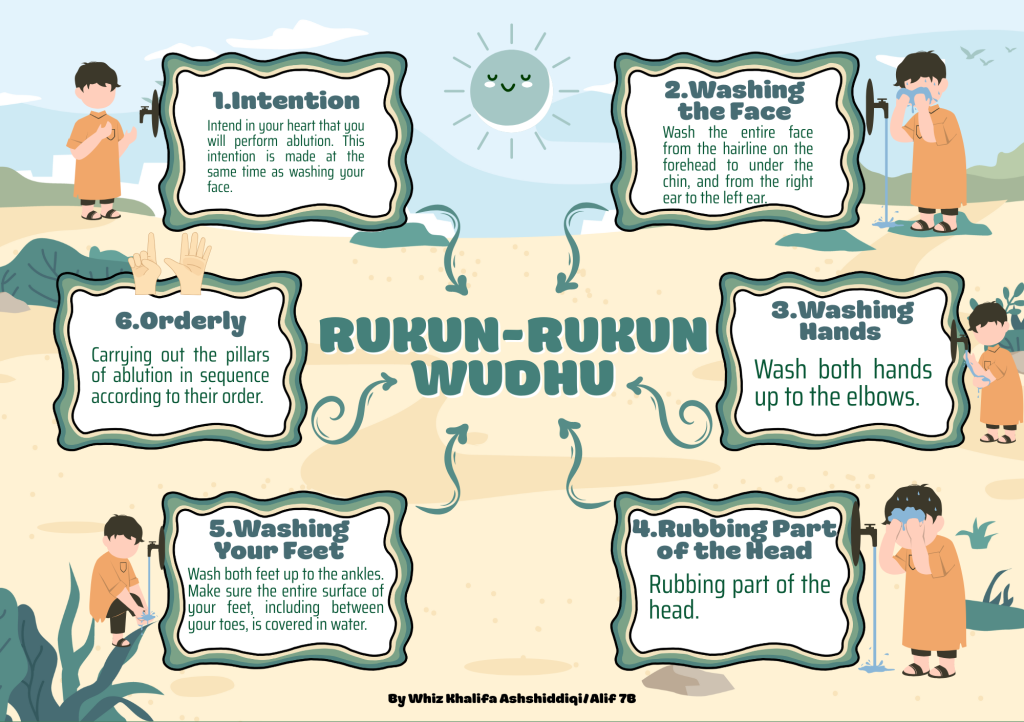
In Islam, wudu (ablution) is a ritual purification required before performing certain acts of worship, such as the daily prayers (salah). The pillars (rukun) of wudu are the essential actions that must be completed correctly for the wudu to be valid. These pillars are based on the Qur’an and Hadith, and they are as follows:
Intention (Niyyah)
The intention to perform wudu must be made in the heart before beginning. It is not necessary to say it out loud, but one must be aware that they are purifying themselves for the purpose of worship.
Washing the Face
This includes rinsing the mouth and nose, and washing the entire face from the forehead to the chin and from ear to ear.
Washing the Arms up to the Elbows
Both arms must be washed thoroughly from the fingertips to the elbows, including the elbows.
Wiping over the Head (Masah)
This involves wetting the hands and passing them over the head, starting from the front to the back and back to the front.
Washing the Feet up to the Ankles
Both feet must be washed completely, including between the toes, up to and including the ankles.
Observing the Correct Order (Tartib)
The steps of wudu must be performed in the proper sequence as prescribed in Islamic teachings
These six pillars form the foundation of a valid wudu. If any of them is omitted or done incorrectly, the wudu must be repeated.